Car Air Conditioning Repair in Las Vegas
Warm air needs diagnosis, not an automatic recharge
Car air conditioning can stop cooling because of low refrigerant, an airflow problem, an electrical fault, or a compressor-control issue. Mobile Mechanic dot Vegas can help identify the likely cause and determine which work is suitable at your location. Adding refrigerant without understanding the fault can leave you with the same warm vents again.
Explain whether the system never cools, cools only while moving, or changes temperature during a trip. Those details help distinguish a refrigerant concern from a condenser fan, cabin airflow, or temperature-door problem. Exact vehicle information is essential because refrigerants, oils, and service procedures vary.
What different AC symptoms suggest
- Strong airflow that stays warm may involve refrigerant charge, compressor operation, a control fault, or unwanted heater-air mixing.
- Weak airflow at every temperature setting may involve the cabin filter, blower motor, electrical supply, or an airflow restriction.
- Cooling that improves at road speed can suggest insufficient condenser airflow, but testing is needed before replacing a fan.
- One side warmer than the other may involve a temperature door or actuator, although refrigerant issues can also produce uneven cooling.
- Cooling that fades after initially working may involve icing, a sensor, an electrical interruption, or another intermittent condition.
A musty odor does not by itself prove a refrigerant leak. Cabin contamination, moisture, and drainage concerns need their own inspection. Clear water beneath a vehicle after AC use is often normal condensation; oily residue, coolant loss, unusual smells, or water entering the cabin deserve a more specific check.
What an AC assessment should examine
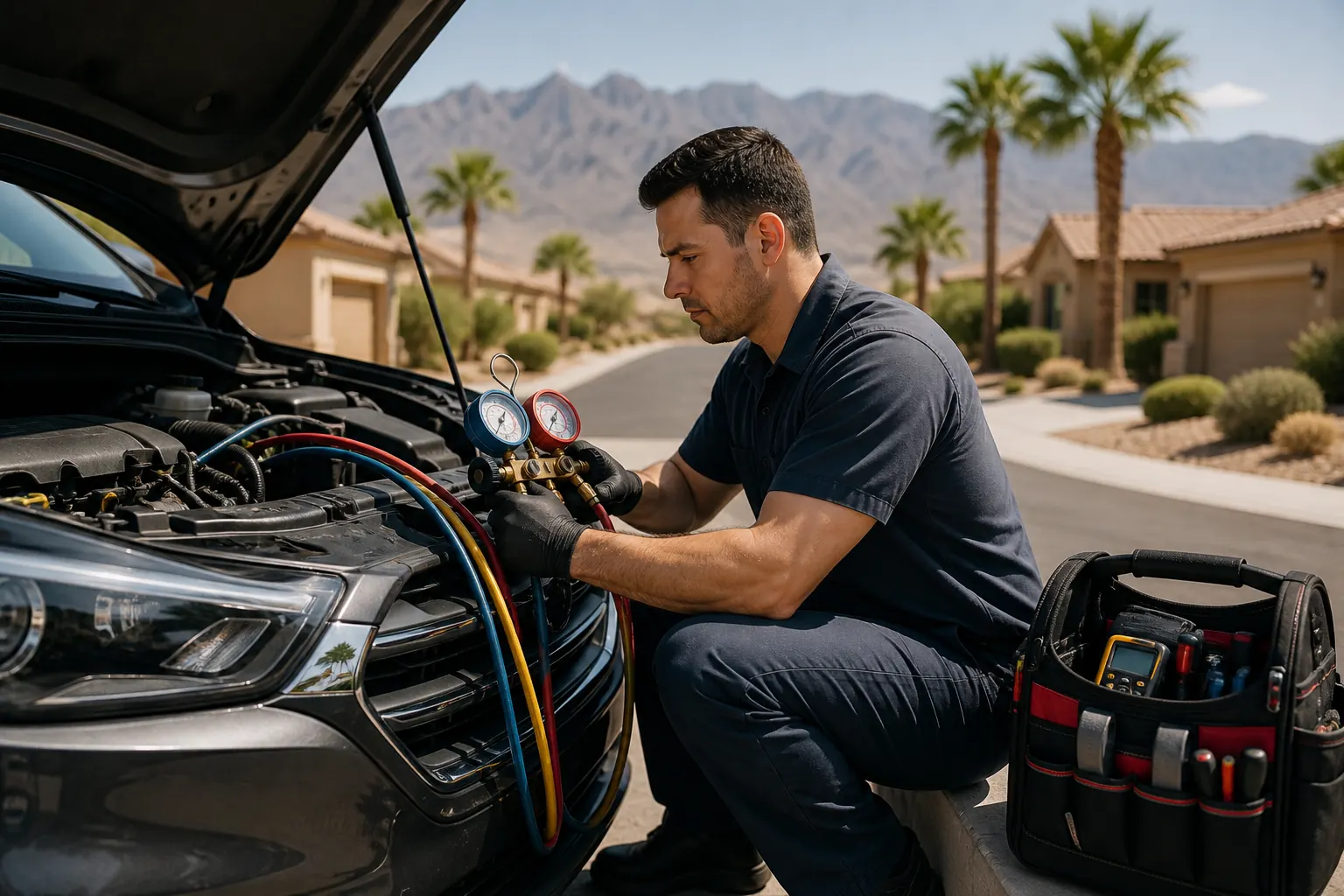
The starting point is your complaint, ambient conditions, vent temperature, airflow, and how the controls respond. A useful evaluation considers both sides of the system: the refrigerant circuit that moves heat and the cabin equipment that directs air. A cold evaporator does little good if air cannot pass through it.
Visual checks may identify damaged lines, oily areas, condenser damage, belt concerns, or fan problems. Electrical and scan-data checks can help establish whether the compressor and fans are being commanded and whether sensors are reporting plausible values. Modern variable-displacement or electric compressors do not all behave like older clutch-driven designs.
Where refrigerant testing is appropriate, compatible service equipment and vehicle specifications matter. Pressure readings depend on conditions and cannot always determine the exact amount of refrigerant in the system. A correct charge is based on the specified type and quantity using suitable procedures, not guesswork from a single gauge.
Why leak checks matter
Refrigerant circulates in a sealed system; it is not a routine consumable that should disappear every season. A low charge may indicate a leak or a previous service problem. Ask what evidence supports adding refrigerant and what testing can be done to locate the loss.
Leak detection may use suitable electronic equipment, approved dye inspection, or other methods appropriate to the vehicle and condition. Small or intermittent leaks can be difficult to confirm during one visit. An honest result may be that further observation or access is necessary rather than a claim that every leak can be found immediately.
Leak-stop products can complicate diagnosis and contaminate service equipment. Tell us about any cans, sealants, refrigerants, or oil previously added. Different refrigerants must not be mixed, and the correct compressor oil is especially important on systems with electrically driven compressors.
Compressor replacement is not always the complete repair
A compressor can fail internally, lose electrical control, or be prevented from operating by another condition. Replacing it without checking the cause risks unnecessary expense or a repeat failure. Compressor diagnosis should account for the rest of the system and the vehicle’s control strategy.
If internal damage has spread debris, related components and contamination management may become part of the repair. Receiver-driers, accumulators, expansion devices, or condenser decisions depend on system design and the failure. These should be explained as findings and procedure requirements, not automatically bundled into every warm-air complaint.
Some jobs require refrigerant recovery equipment, significant front-end access, or dashboard removal. Those requirements can exceed a practical mobile visit. Before authorizing an involved repair, ask what can be completed on-site and what would require a shop or specialist equipment.
Safe AC service in Las Vegas heat
Do not reach toward fans or belts to check whether they are turning. Electric cooling fans can start unexpectedly. Never loosen refrigerant fittings or try to vent a system; pressurized refrigerant can cause injury and needs proper recovery and handling.
A nonworking AC system is also a passenger-safety concern in extreme heat. Do not leave children, vulnerable adults, or animals in a parked vehicle while waiting for repair. Move everyone to a safe, cooler location. If someone is trapped or showing signs of heat illness, contact emergency services instead of waiting for a service appointment.
Engine overheating and poor AC cooling can occur together, but an AC repair is not a substitute for cooling-system diagnosis. Stop safely if the temperature warning rises and follow the overheating guide. Additional electrical concerns can be investigated through vehicle diagnostics.
Preparing for a vehicle-specific quote
Provide the year, make, model, engine, and VIN if available, plus the refrigerant label information if it is easily visible without reaching near moving parts. Mention prior AC work, collision damage, aftermarket components, and exactly when cooling changes.
Ask whether the proposed scope includes diagnosis, leak testing, refrigerant service, and any identified parts. A quote should distinguish testing from an approved repair and explain uncertainties that need inspection. See pricing information and preventive maintenance for planning, rather than assuming every AC complaint fits one recharge package.
Car AC questions
Will a recharge fix warm air?
Only if refrigerant charge is the relevant problem, and it may not last if a leak remains. Airflow, electrical, control, and mechanical faults can all produce warm vents without being solved by adding refrigerant.
Can you work on every vehicle refrigerant system on-site?
Vehicle type, refrigerant, equipment compatibility, and repair access determine feasibility. Share the vehicle details before booking so the appropriate service and any shop requirement can be confirmed.
Why does the AC cool while moving but not at a stop?
Reduced condenser airflow is one possibility, but charge level, compressor control, and other conditions can produce similar symptoms. Fan operation and system behavior should be tested before choosing a repair.
Request service at your location
Mobile Mechanic dot Vegas serves Las Vegas, North Las Vegas, Henderson, Summerlin, Spring Valley, Enterprise, and Paradise. Check our service areas and describe the vehicle’s exact location so access and suitability can be confirmed. Call 725-277-5350 or use the contact page to discuss the vehicle, symptoms, and proposed work before booking.