
Battery Replacement in Las Vegas
Find out whether the battery needs replacing
A slow crank, repeated clicking, or a dead dashboard can point to a weak battery, but loose connections and charging faults can look similar. Mobile Mechanic dot Vegas helps determine whether battery replacement fits the problem and whether the vehicle can be serviced safely where it is parked.
The goal is more than getting the engine to start once. A replacement needs the correct specification, secure installation, and any vehicle-required setup. If something else is draining the battery or preventing it from charging, that problem needs attention too.
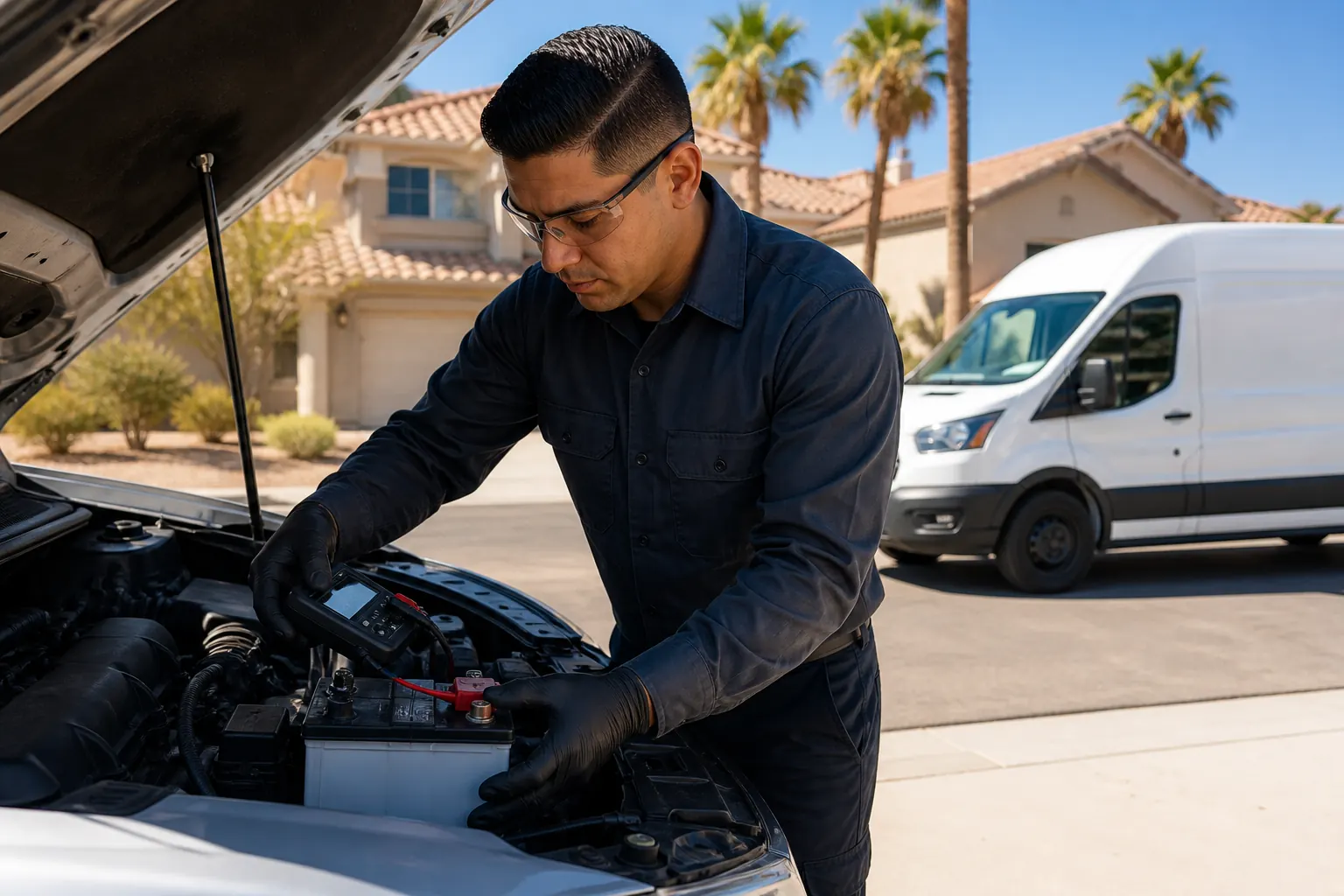
Describe exactly what happens when you try to start
- Rapid clicking or lights that dim heavily during a start attempt can indicate low available power or a high-resistance connection.
- A slow, uneven crank may involve battery condition, cable losses, or an excessive starter load.
- A single click with otherwise bright lights can involve the starter circuit; it does not prove the battery is healthy or faulty.
- Normal engine cranking without starting usually calls for diagnosis beyond simply replacing the battery.
- A battery that repeatedly goes flat after parking may have a drain, inadequate charging, or reduced capacity.
Tell us whether a jump-start helped and how long the vehicle had been parked. Note recent accessory installations, lights left on, short-trip use, and previous battery replacements. The car won’t start guide helps separate no-crank symptoms from an engine that cranks but will not run.
What a battery assessment should include
Battery condition cannot be judged from age or a single resting-voltage reading alone. Inspection starts with the case, terminals, cable connections, and hold-down. A damaged, swollen, leaking, or unusually hot battery requires special care and may be unsafe to test or jump-start.
Testing should account for the battery’s type, rated performance, temperature, and state of charge. A discharged battery can require charging and retesting before its condition can be judged fairly. Test results should be interpreted alongside the starting complaint rather than used as a reason to sell a battery automatically.
Connections matter because corrosion or looseness can restrict current even when the battery itself is serviceable. Cable and ground testing may be needed when the symptoms persist. On vehicles that can run, evaluating charging performance can help reveal why the original battery lost charge.
Choosing the correct replacement
Battery size, terminal position, mounting style, venting requirements, and electrical rating must suit the vehicle. Some vehicles require AGM or another specific technology, particularly where stop-start systems or battery-management strategies are involved. Substituting a cheaper but unsuitable battery can affect operation and service life.
The battery may be under the hood, in the trunk, beneath a seat, or behind trim. That location changes access and the work required. Some installations need a vent tube routed correctly, and certain vehicles require registration or adaptation after replacement. These are vehicle-specific requirements, not universal extras.
A small auxiliary battery may also be fitted. Its purpose and replacement procedure can differ from the main starting battery. Hybrid and electric vehicles use low-voltage systems too, but a low-voltage battery service must not be confused with high-voltage traction-battery work. Describe the powertrain when requesting service.
Why a new battery can go flat again
If the charging system is not replenishing energy, replacing the battery treats the result rather than the cause. A warning light, dimming while driving, or stalling after a jump-start deserves investigation through starter and alternator diagnosis, not repeated jump-starts.
An electrical drain can also discharge a good battery while the vehicle is off. Modern modules may take time to enter sleep mode, so proper drain testing needs a suitable setup and cannot always be finished in a brief visit. Unplugging random components or replacing the battery repeatedly may conceal the pattern without fixing it.
Short trips and long storage periods can contribute to low charge even without a failed component. Explain your normal driving pattern. If a maintainer is appropriate, it must be compatible with the battery and connected according to the vehicle’s instructions; it is not a cure for a faulty charging system.
Battery safety and mobile access
Do not lean over a damaged battery, create sparks near it, or attempt to open a sealed case. Batteries can release flammable gas and contain corrosive material. Avoid touching spilled fluid. If there is smoke, fire, or an immediate threat, move away and contact emergency services.
For a parked vehicle, provide a clear, legal space with access to the battery location. Tell us if the hood cannot open, the doors are locked, or the vehicle is in a garage with restricted clearance. An engine must not run in an enclosed garage, even with the main door open.
Jump-start procedures vary, especially on hybrids and vehicles with designated remote terminals. Follow the owner’s manual rather than guessing at connection points. If you cannot identify the correct procedure, leave the vehicle off and ask for help.
Quoting and checking the finished installation
Have the year, make, model, engine, and VIN available if possible. A photo of the existing battery label can help, but it should not override the manufacturer’s requirement. Ask whether the quote includes the battery, installation access, required setup, and handling of the old battery. Review pricing information before approving the agreed scope.
After replacement, the battery should be secured and connections checked. Starting and relevant electrical operation should be verified, with any remaining warnings explained. Some convenience settings may need to be restored. A successful start does not, by itself, rule out an intermittent drain.
Battery replacement questions
Will a jump-start prove I need a new battery?
No. It shows that additional electrical support helped at that moment. Testing is still needed to distinguish a worn battery from discharge, connection trouble, or a charging fault.
Does Las Vegas heat affect a battery?
High temperatures can accelerate battery deterioration, but local weather alone does not establish replacement need. Condition testing and the correct battery specification are more useful than choosing a replacement solely by age.
Can you replace any hybrid battery?
Do not assume that low-voltage battery service includes the high-voltage traction battery. Provide the exact vehicle and concern so the appropriate service scope and equipment can be confirmed before a visit.
Request service at your location
Mobile Mechanic dot Vegas serves Las Vegas, North Las Vegas, Henderson, Summerlin, Spring Valley, Enterprise, and Paradise. Check our service areas and describe the vehicle’s exact location so access and suitability can be confirmed. Call 725-277-5350 or use the contact page to discuss the vehicle, symptoms, and proposed work before booking.
Flexible pricing with a clear estimate before work begins
- Service call: $100–$300. The applicable fee depends on the visit, location, travel time, and technician availability.
- Labor: $100–$300 per hour, billed per quarter hour. That is $25–$75 per quarter hour at the agreed rate.
- Parts are additional. Parts pricing depends on the vehicle, availability, sourcing, and warranty terms.
Our goal is affordable, convenient mobile service, with premium pricing available for urgent, difficult, remote, or specialist jobs. Ask for an itemized estimate before dispatch. Service-call charges, labor, and parts are separate; confirm any applicable taxes and other charges. Emergency roadside assistance remains available 24/7. After-hours timing can affect your quote; there is no longer a single fixed after-5:00-p.m. rate.
See service times and the battery replacement cost example for a breakdown of the service call, labor, and additional parts.