24/7 Emergency Roadside Assistance in Las Vegas
24/7 emergency roadside assistance in Las Vegas. Call 725-277-5350 day or night. Confirm dispatch, arrival estimate, safe access, and any after-hours charges when you call. Call 911 for immediate danger or a medical emergency.
Roadside help starts with a safe location
If your vehicle stops unexpectedly, protecting people comes before identifying the failed part. Mobile Mechanic dot Vegas can discuss the symptoms and assess whether the location and problem are suitable for mobile help. Some breakdowns can be evaluated where the car sits; others require towing before any repair is practical.
Call 725-277-5350 to describe your location and situation. Availability and the appropriate response must be confirmed directly. Do not rely on a service-page visit as confirmation that help has been dispatched, that an arrival time is guaranteed, or that a dangerous roadside location can be worked in safely.
What to do while deciding your next step
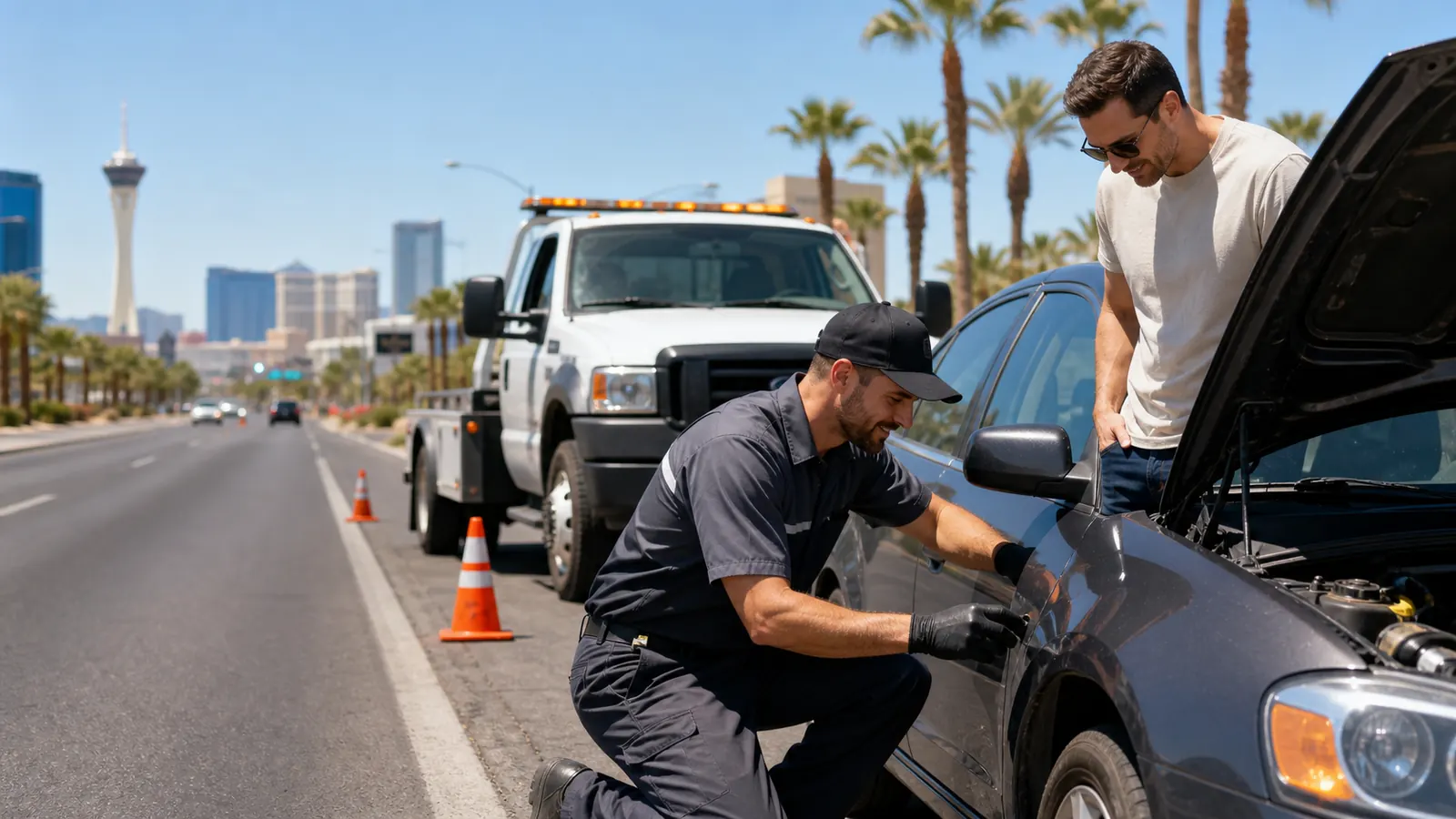
If the vehicle remains controllable, move out of active traffic only when it is safe to do so. Use hazard lights where appropriate. Do not push a vehicle in moving traffic or attempt a roadside repair in a travel lane. If you cannot reach a safe position, contact emergency services or highway assistance.
Whether to remain inside or exit depends on the scene. Consider traffic, barriers, fire, smoke, and the safety of a possible exit route. Do not step into traffic to inspect a wheel or lift the hood. Follow instructions from emergency responders when they are involved.
If there is fire, smoke, a significant fuel leak, injury, or immediate danger, call 911. A mechanic appointment is not a substitute for emergency response. In severe heat, prioritize a safe, cooler place for occupants, especially children, older adults, and animals, without walking into traffic or another hazard.
Details that help assess a roadside request
- Give your exact location, direction of travel, nearest exit or cross street, and a safe location pin if available.
- Explain whether you are in a travel lane, shoulder, parking lot, driveway, or another protected area.
- Share the year, make, model, engine or powertrain type, and whether the vehicle rolls or steers normally.
- Describe the event: engine stopped, would not restart, temperature rose, warning appeared, tire failed, or keys became inaccessible.
- Mention passengers at risk, visible leaks, smoke, unusual smells, collision damage, and any police or tow assistance already involved.
Keep your phone available for coordination, but do not use it while driving. If the vehicle is moved after you call, update the location. Parking-structure height, gated access, and property rules matter just as much as the street address when the breakdown occurs off the road.
When the vehicle will not start
No-crank and crank-but-no-start problems need different checks. Clicking, dim lights, or a slow crank can involve battery power or connections. Normal cranking without starting can involve fuel, ignition, engine controls, or mechanical conditions. Share the exact behavior rather than requesting a battery solely because the engine will not run.
A jump-start may help a discharged battery, but it is not appropriate in every situation and does not prove the battery needs replacement. Damaged batteries and unfamiliar hybrid or electric systems require particular caution. See car won’t start and battery testing and replacement for the relevant next steps.
If the vehicle starts with assistance but a charging warning stays on or the engine stops again, repeated jumps may not solve the problem. Charging-system diagnosis can determine whether the battery is being replenished or another fault is present.
Overheating and fluid-loss breakdowns
A high temperature warning, steam, or coolant loss is a reason to stop safely and avoid continuing to drive. Do not remove a hot cooling-system cap. Pressurized coolant can cause serious burns even after the engine has been switched off. Keep clear of fans and moving components.
Allowing an engine to cool does not establish that the cause is fixed. A leak, fan fault, belt problem, or internal issue may still be present, and restarting can cause further damage. Use the overheating page for safety guidance and discuss whether towing is the safer choice.
A red oil-pressure warning, severe mechanical noise, or rapid fluid loss can also make restarting inappropriate. Describe these symptoms during the initial call so the response does not begin with an unsafe request to run the engine again.
Tires, lockouts, and services that need confirmation
Do not assume a general roadside request includes every recovery service. Tire equipment, spare condition, locking wheel nuts, vehicle weight, and a safe lifting surface affect whether tire-related help is feasible. A damaged wheel, unstable shoulder, or missing usable spare may make towing necessary.
For inaccessible keys, see vehicle lockout service. The vehicle’s lock system and proof of authorized access matter. A child, vulnerable person, or animal trapped in dangerous heat requires emergency services first, not a normal lockout appointment.
Fuel delivery, towing, specialized recovery, and key programming should not be assumed to be included. Ask directly which service can be provided or whether another provider is needed. Clear limits prevent losing time waiting for assistance that does not match the situation.
Why roadside repairs sometimes need a shop
A mobile assessment is not permission to work beside fast-moving traffic. Safe approach, stable ground, legal access, lighting, weather, and room for equipment all affect feasibility. Even a straightforward component replacement can be unsuitable in the wrong location.
A shop may be required for extensive lifting, major disassembly, specialized equipment, or a fault that needs prolonged testing. If the vehicle cannot be made safe at the scene, arrange towing rather than trying to drive it to a more convenient parking space. Tell the tow provider the powertrain and any wheel or steering restrictions.
Agree on the scope before service
Ask what the proposed visit includes, which symptoms can be assessed, and what happens if an on-site repair is not possible. A quote should be based on the vehicle, location, and likely work; additional diagnosis or parts should require a clear explanation and approval. Consult pricing information before authorizing the agreed service.
Roadside assistance questions
Can you promise an arrival time from this page?
No. Contact the business to confirm availability, location suitability, and the expected response. If there is immediate danger, contact emergency services rather than waiting for a routine dispatch decision.
Can every disabled vehicle be repaired roadside?
No. Traffic exposure, access, vehicle design, and the fault can require towing or shop equipment. The safest useful outcome may be identifying why the vehicle should not be driven.
Should I keep trying to restart the engine?
Avoid repeated attempts, especially with grinding, smoke, fuel smell, overheating, or an oil-pressure warning. Describe what happened and seek guidance before further attempts that could worsen damage or create a hazard.
Request service at your location
Mobile Mechanic dot Vegas serves Las Vegas, North Las Vegas, Henderson, Summerlin, Spring Valley, Enterprise, and Paradise. Check our service areas and describe the vehicle’s exact location so access and suitability can be confirmed. Call 725-277-5350 or use the contact page to discuss the vehicle, symptoms, and proposed work before booking.
Flexible pricing with a clear estimate before work begins
- Service call: $100–$300. The applicable fee depends on the visit, location, travel time, and technician availability.
- Labor: $100–$300 per hour, billed per quarter hour. That is $25–$75 per quarter hour at the agreed rate.
- Parts are additional. Parts pricing depends on the vehicle, availability, sourcing, and warranty terms.
Our goal is affordable, convenient mobile service, with premium pricing available for urgent, difficult, remote, or specialist jobs. Ask for an itemized estimate before dispatch. Service-call charges, labor, and parts are separate; confirm any applicable taxes and other charges. Emergency roadside assistance remains available 24/7. After-hours timing can affect your quote; there is no longer a single fixed after-5:00-p.m. rate.
See service times and the battery replacement cost example for a breakdown of the service call, labor, and additional parts.